
You've heard the phrase a hundred times. "He was beaten for us." "He took the stripes." "By His stripes we are healed" (Isaiah 53:5). It rolls off the tongue so easily in a sermon or a worship song that it's possible to sing it, quote it, even build a whole theology on it, without ever actually knowing what it means. What instrument. What technique. What it physically did to a human body.
This article exists to close that gap not for shock value, but because the specific, physical reality of what Jesus endured before He ever reached the cross is part of what makes "by His stripes we are healed" more than a poetic phrase. It's a medical and historical fact with a body attached to it. His.
It Wasn't a Cane. It Was Something Far Worse.
The word "cane" undersells what actually happened. A cane implies a single rod, a controlled strike, something almost disciplinary. What Jesus was beaten with was an entirely different category of instrument one the Romans built specifically to shred, not just to strike.
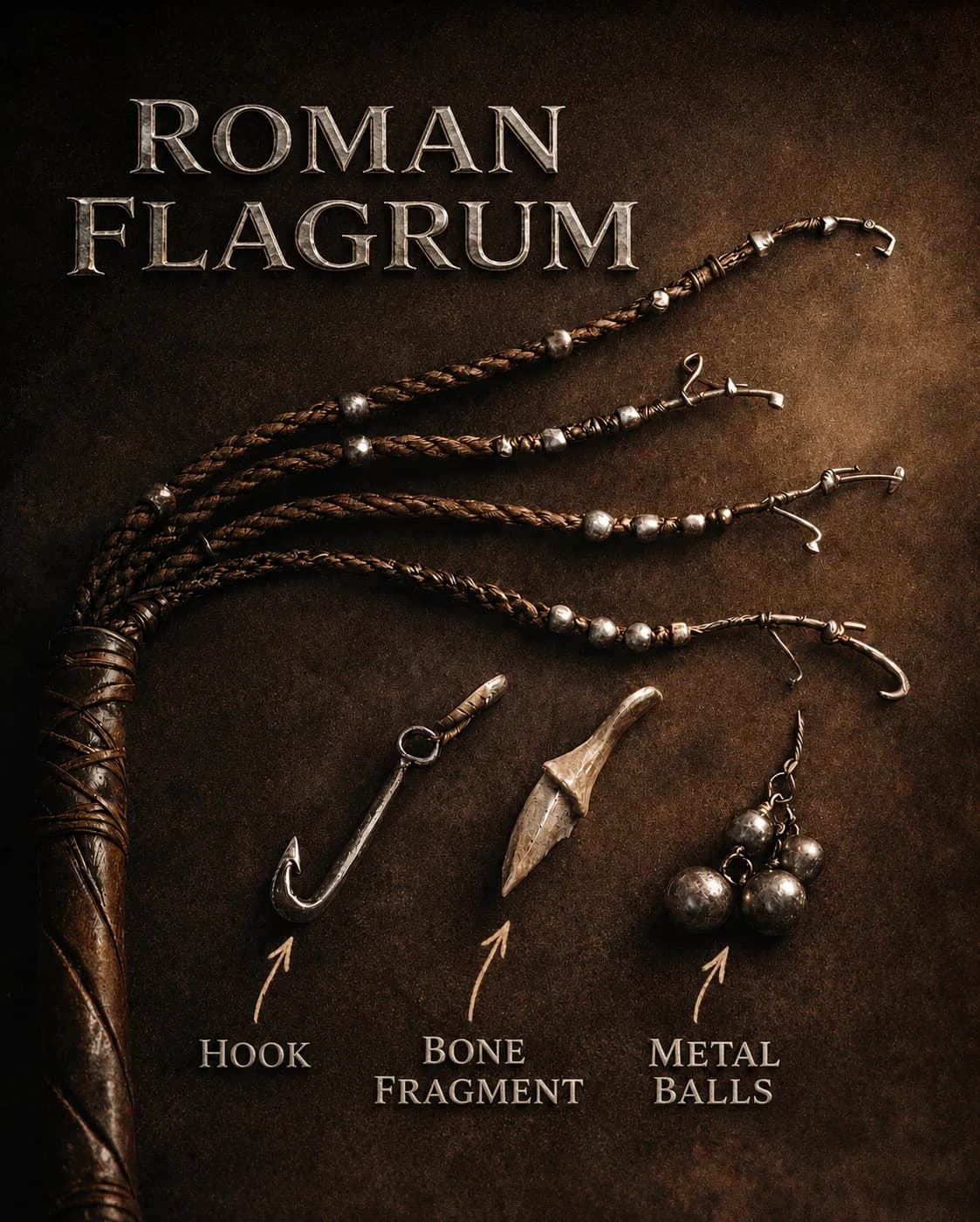
It was called the flagrum, sometimes the flagellum a short-handled whip with multiple leather thongs, typically two or three, though some versions had more. Historical accounts describe it as a short whip made of leather straps connected to a handle, with the straps knotted with metal and sometimes sharp bones, such as the knucklebone of a sheep. Some versions carried a small hook at the tip, earning a nickname among Roman soldiers that translates roughly to "scorpion" because that's exactly what the wound looked like when the metal tip bit into flesh and ripped back out.
This wasn't a punishment designed merely to hurt. It was designed to strip flesh from the body quickly, leaving skin hanging in ribbons and, in the worst cases, exposing the internal organs beneath.
We Know This Isn't Guesswork — Archaeology Confirms It
For centuries, historians only had ancient written descriptions to go on. That changed in 1709, when archaeologists excavating the buried Roman city of Herculaneum sealed in volcanic ash from the same eruption of Mount Vesuvius that destroyed Pompeii in 79 AD unearthed an actual first-century Roman flagrum, finally revealing what the instrument really looked like.
That discovery matters more than it might first appear. Researchers studying the Shroud of Turin the linen cloth some believe wrapped the body of Jesus later compared the pattern of wounds on the cloth to the shape of the Herculaneum flagrum. The dumbbell-shaped tips found on the excavated Roman scourge matched the scourge marks on the Shroud with striking precision. Whatever your view on the Shroud's authenticity, the archaeology tells us something concrete: the flagrum was real, it was recovered, and its physical dimensions are no longer a matter of guesswork.
Researchers examining Roman-era art have found other supporting evidence too carved reliefs and sarcophagi from the early centuries AD depicting victims being scourged with tools matching this same brutal design, confirming that this wasn't an obscure or rare device. It was a standard, recognized instrument of Roman punishment.
How the Beating Actually Happened
The Gospels state the fact plainly and without elaboration: "Then released he Barabbas unto them: and when he had scourged Jesus, he delivered him to be crucified" (Matthew 27:26). "And so Pilate, willing to content the people, released Barabbas unto them, and delivered Jesus, when he had scourged him, to be crucified" (Mark 15:15). John records it even more starkly: "Then Pilate therefore took Jesus, and scourged him" (John 19:1).
Four words. One sentence. The Gospel writers don't linger on it but historians and researchers who've studied Roman scourging in depth have reconstructed the process from surrounding evidence.
The condemned man was stripped and bound typically to a low post or pillar, arms secured above or in front of him, back and shoulders fully exposed. Roman practice was to beat the back and chest with the flagrum starting at the upper torso and working downward in a V-shaped pattern, sometimes followed by reeds used to strike the arms and legs as well. Two soldiers, called lictors, would often work from opposite sides, alternating blows so the beating never paused, never let the body recover for even a second between strikes.
There was no fixed number of lashes under Roman law unlike Jewish law, which explicitly capped punishment at forty stripes, and in practice usually thirty-nine, to avoid accidentally exceeding the limit and violating the command in Deuteronomy: "Forty stripes he may give him, and not exceed" (Deuteronomy 25:3). Paul himself later wrote that he had received this exact punishment "of the Jews five times received I forty stripes save one" (2 Corinthians 11:24) a punishment severe enough to nearly kill a man, administered under a legal ceiling.
Rome had no such ceiling. Roman scourging, historians note, was deliberately calibrated to inflict the maximum possible damage on a victim's body while stopping just short of killing them outright refined over centuries into a science of controlled near-death torture. The number of lashes was left entirely to the discretion of the soldiers carrying it out, and by the time of Jesus, Roman scourging preceding crucifixion had earned its own grim reputation. One ancient writer, Josephus, described condemned men as being "first scourged" before crucifixion a phrase historians note was never used casually, since other ancient sources described bodies being torn open "down to the deep-seated veins and arteries" by this exact instrument.
What This Actually Did to a Human Body
In 1986, the Journal of the American Medical Association published a detailed medical analysis of the crucifixion, written by a pathologist and two co-authors who examined the physical evidence and historical record with clinical precision. Their findings on the scourging alone are difficult to read and important to understand.
The scourging produced deep, stripe-like lacerations and significant blood loss, likely setting the stage for hypovolemic shock a life-threatening condition caused by the body losing too much blood too quickly. The researchers noted physical evidence for this conclusion sitting in plain sight in the Gospel account itself: Jesus was too physically weakened afterward to carry His own crossbeam to Golgotha the same crossbeam a healthy man could ordinarily be expected to carry, which is why the soldiers pulled Simon of Cyrene from the crowd to carry it instead.
Hypovolemic shock isn't a minor detail. It's what happens when blood loss becomes so severe that the heart can no longer pump enough blood to maintain blood pressure and oxygen delivery to vital organs. Symptoms include a racing heart, rapid shallow breathing, extreme weakness, disorientation, and eventually collapse. Medical researchers examining the crucifixion account believe Jesus was already moving through the early stages of this exact condition before a single nail was driven which reframes everything that followed. The walk to Golgotha, the collapse under the crossbeam, the need for Simon's help none of it was weakness of character or spirit. It was a body already in physiological crisis from a beating designed to bring it there.
The Detail Most People Miss: This Happened Before the Crown of Thorns, Before the Cross
It's easy, hearing the crucifixion story told quickly, to picture the cross as the main event and everything before it as a kind of prelude. The historical and medical record suggests something different: by the time Jesus reached Golgotha, His body had already been brought to the edge of death once.
The scourging came first. Then the mockery a crown pressed into His already-lacerated scalp, a robe thrown over torn and bleeding shoulders, soldiers striking Him further with their hands and a reed. Then the forced march, carrying a beam He no longer had the strength to carry. Only after all of that did the actual crucifixion begin the nails, the raising of the cross, the hours of suffocating slowly under His own weight.
This is why the Gospel writers, when they simply state "he scourged him" in a single clause, aren't understating the moment by accident. They're often assuming their original audience people living inside the Roman Empire, who had likely witnessed scourging themselves, or at least knew exactly what the word implied — didn't need it spelled out. It was common knowledge in the first century in the way we might casually reference a well-known but horrific practice today. The horror was assumed, not explained.
We, two thousand years and an ocean of cultural distance later, need it explained. That's what the archaeology and the medical research are for.
Why This Matters for Faith, Not Just History
None of this research exists to be gratuitous. It exists because Isaiah's prophecy written roughly 700 years before it happened didn't say "by His death we are healed." It said "by His stripes we are healed" (Isaiah 53:5). The stripes. The specific, physical, torn-flesh reality of the flagrum meeting skin, over and over, administered by trained soldiers who had done this many times before and knew exactly how far a human body could be pushed without dying.
Peter later wrote about this same detail, decades after witnessing crucifixions himself as a common Roman practice of his era: "who his own self bare our sins in his own body on the tree... by whose stripes ye were healed" (1 Peter 2:24). Peter had almost certainly seen a Roman scourging before. He wasn't speaking in vague poetic terms. He was pointing at something specific, something he understood the horror of firsthand, and saying: that is what purchased your healing.
Understanding the flagrum doesn't make the gospel more graphic for the sake of being graphic. It makes the weight of "He did this for you" concrete instead of abstract. It's the difference between knowing someone was generous and knowing exactly what they gave up to be generous.
The next time you hear "by His stripes we are healed," you now know what a stripe actually was. Leather. Bone. Metal. A soldier trained to inflict exactly this much damage and no more. A body already approaching shock before it ever reached the cross.
He knew what was coming. He walked toward it anyway.
But the Scourging Wasn't the Last Thing Science Would Confirm
Here's what almost nobody talks about: hours later, after Jesus had already died on the cross, a Roman soldier drove a spear into His side and John, standing close enough to witness it, recorded something strange coming out of the wound. Not just blood. Blood and water.
For centuries, that detail sat in the Gospel of John as a curious, almost throwaway observation. Then modern medicine caught up and what doctors discovered about that exact phenomenon is one of the most quietly stunning pieces of evidence in the entire crucifixion account.
Next up: "The Spear, the Blood, and the Water — What John Saw That Science Took 1,900 Years to Explain." You'll want to read this one before you ever look at John 19:34 the same way again.
Sources referenced include archaeological findings from Herculaneum, comparative studies of Roman-era scourging tools, and the 1986 medical analysis published in the Journal of the American Medical Association, "On the Physical Death of Jesus Christ" by Edwards, Gabel, and Hosmer. This article is intended for devotional and educational reflection.