


You almost walk past it.
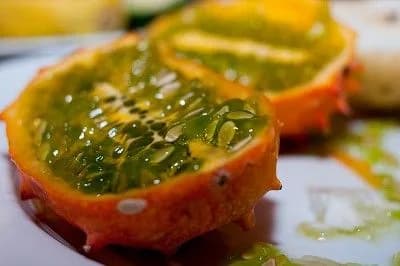
At the market stall, wedged between the ripe mangoes and the neat rows of bananas, sits something that looks like it doesn't belong in a fruit basket at all bright orange-yellow, studded all over with blunt spikes, like a small alien egg someone forgot to hide. It doesn't invite you the way a strawberry does. It dares you.
This is thorn melon. Some call it kiwano. Others know it as horned melon, jelly melon, or African horned cucumber. And once you cut it open, you understand why people who try it once rarely forget it.
What's Actually Inside That Spiky Shell
Slice through the tough outer skin and the fruit reveals itself completely differently from how it presents. Inside is a bright, almost glowing lime-green (sometimes emerald or pale yellow) jelly, packed with edible seeds, each one suspended in its own little pocket of pulp. The texture is somewhere between a cucumber and a passionfruit slippery, cool, faintly crunchy from the seeds. The taste is mild: a little banana, a little cucumber, a little citrus, depending on ripeness.
One rule matters here: the skin is not for eating. It's tough, bitter, and meant to be scooped past, not chewed.
Where This Fruit Comes From
Thorn melon isn't new it's ancient, actually. It originates from the semi-arid regions of Sub-Saharan Africa, and it still thrives there today, especially in drought-prone areas. In Kenya, it's grown successfully in counties like Machakos, Makueni, Kitui, Baringo, Laikipia, and parts of Kajiado — regions where many other crops struggle against the heat and unreliable rain.
Thorn melon is a drought-tolerant fruit native to Sub-Saharan Africa and now widely grown in Kenya, thriving in semi-arid regions that make it a reliable crop for farmers.
That resilience is part of the story a fruit built to survive hardship, and in doing so, it became something people leaned on for their own health.
Traditionally, communities have used it to manage hypertension, support fertility, cleanse the blood, and strengthen the body during hot seasons.
The Nutrition Behind the Novelty
Strip away the strange appearance, and thorn melon holds its own against far more famous fruits.
It's mostly water — and that's a good thing. Kiwano is about 88% water by weight, which is even higher than the water content of watermelon.That makes it one of the most hydrating fruits you can eat, especially useful in hot climates or after physical exertion.
It's low in calories. A 100-gram serving of fresh horned melon contains just around 44 calories, while still delivering a real nutritional payload not empty water weight.
It's rich in iron. Kiwano is a strong source of iron, a nutrient the body cannot produce on its own and must get through diet, making it valuable for preventing iron deficiency anemia one of the most common nutritional deficiencies worldwide.This iron helps the body produce hemoglobin, the protein that carries oxygen through red blood cells, and also supports myoglobin, which supplies oxygen to muscles.
It supports heart health. The fruit is abundant in magnesium, a mineral that helps relax the heart and body muscles, regulate blood pressure, and protect against cardiovascular disease.
It's loaded with antioxidants. Thorn melon contains a significant number of antioxidants that help guard against diabetes, heart disease, cancer, and other chronic conditions, alongside vitamin C, vitamin A, and lutein.
It protects your eyesight. Kiwano contains zinc, which has been linked in research to a lower risk of age-related macular degeneration a condition that can lead to blindness.
It may strengthen bones.The magnesium in kiwano supports bone health, since a deficiency in this mineral has been linked to fragile bones and osteopenia.
It aids digestion.The dietary fiber in kiwano encourages regular digestion, and the fruit's natural gelatin may help ease constipation, cramping, and bloating.
Even the seeds pull weight. The seeds are rich in minerals like magnesium, manganese, copper, and selenium, along with modest amounts of protein and fat.
One Thing to Watch For
As with many members of the cucumber family, thorn melon deserves a small note of caution. Because it belongs to the cucurbitaceae family, horned melon can contain compounds called cucurbitacins, which in some cases may cause stomach discomfort, vomiting, or diarrhea.The advice from those who know the fruit well: taste a small spoonful of the pulp before committing to the whole thing, and if it tastes unusually bitter, don't eat the rest.
Why a Fruit Like This Matters
There's something worth sitting with here. Thorn melon isn't grown in ideal, well-watered soil with easy conditions. It survives and even flourishes where the land is hardest, where the sun is most relentless, where other crops give up. And what it produces isn't a shy, quiet fruit either. It's armored on the outside, and yet what's inside is soft, hydrating, and nourishing in ways that go far beyond its strange appearance.
Sometimes the things that look the least inviting at first glance are the ones carrying the most benefit once you're willing to cut past the surface.
Curious what other unusual, resilient fruits carry benefits most people overlook? That's a story for another day.



