


Two Gospel writers. Two very different accounts of the same death. Here's what's actually going on — and why it's not the contradiction it looks like.
Somewhere in Jerusalem, in a field the locals would later call Akeldama the Field of Blood a man who betrayed his closest friend died alone. Everyone agrees on that much. What happened next is where the two earliest written accounts of his death start to disagree, at least on the surface, in a way that has bothered careful readers of the Bible for centuries.
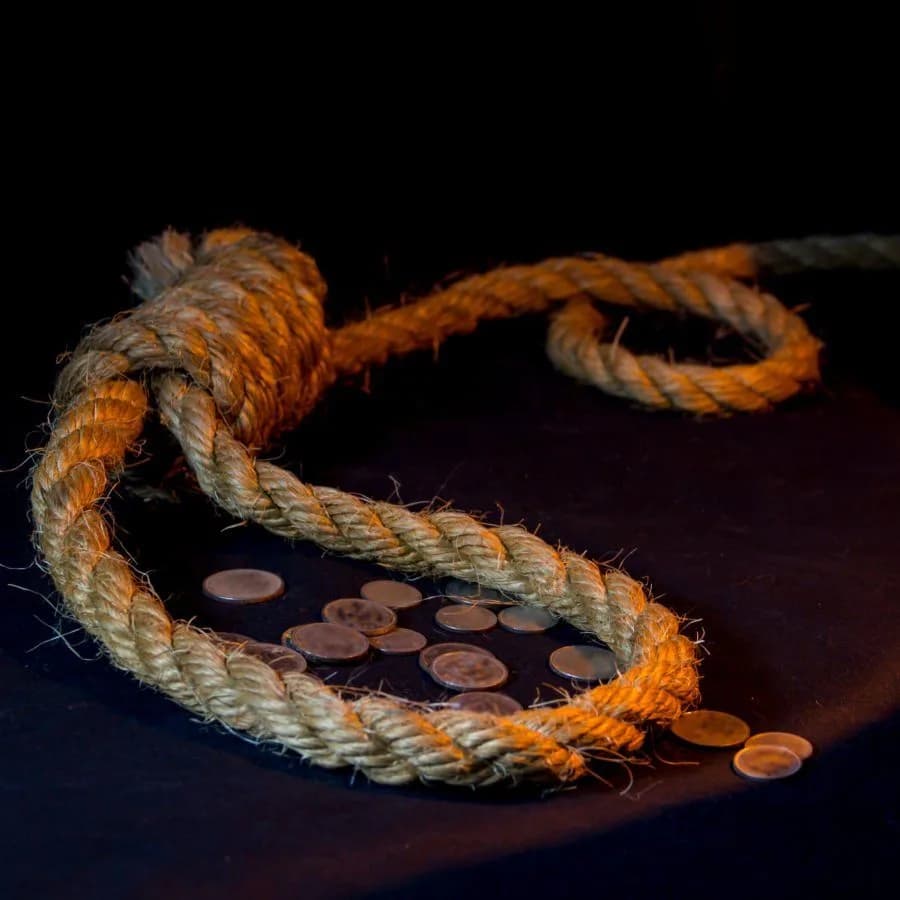
Matthew, writing his Gospel, says this: "And he cast down the pieces of silver in the temple, and departed, and went and hanged himself" (Matthew 27:5).
Luke, writing in the book of Acts, records something that sounds like a completely different scene: "Now this man purchased a field with the reward of iniquity; and falling headlong, he burst asunder in the midst, and all his bowels gushed out" (Acts 1:18).
Hanged himself. Fell headlong and burst open. Read side by side, cold, with no context, it looks like two writers describing two different deaths. Skeptics have pointed to this exact pairing of verses for centuries as one of the clearest examples of the Bible contradicting itself. So what actually happened to Judas? Let's investigate it properly, the way you'd investigate any case with two witness statements that don't obviously line up.
Clue One: A Difference Isn't Automatically a Contradiction
Before assuming these two accounts cancel each other out, it's worth asking a simple investigative question: are these actually describing two different events, or two different aspects of the same event?
Think about how two witnesses might describe a single car accident. One says, "He lost control of the car." The other says, "The car ended up wrapped around a tree, and he was thrown through the windshield." Neither statement contradicts the other — they're simply describing different moments and different details of the same unfolding event. One describes the cause. The other describes the aftermath.
That's closer to what's happening between Matthew and Luke than most people realize.
<cite index="18-1">
A difference between two accounts isn't automatically a contradiction and a mystery in the details isn't the same thing as an error in the record.</cite>
Matthew tells us how Judas chose to end his life. Luke writing decades later, compiling eyewitness testimony as a careful historian tells us what was discovered about his body afterward. These aren't necessarily competing claims. They may simply be two different frames of the same photograph.
Clue Two: The Oldest Proposed Explanation
The traditional harmonization, proposed by scholars for centuries, is actually fairly straightforward once you picture the physical scene: Judas hanged himself from a tree or a branch on a hillside or cliff above the field, likely using a rope or cord tied to a branch that either broke under his weight or was weakened by the passage of time in the heat before his body was discovered.
<cite index="17-1,19-1">The theory holds that Judas hanged himself, and at some point afterward the means of suspension gave way, causing his body to fall onto the rocky ground below — which, particularly after a body has begun to decompose in warm climate conditions, could plausibly result in the kind of rupture Luke describes.
</cite>
It's not a far-fetched picture. Anyone familiar with the terrain around Jerusalem's steep, rocky ravines can imagine it: a body hanging from a tree on a ledge, a branch giving way under the strain, a fall onto jagged rock below. Matthew captures the moment of the decision and the act. Luke captures the state in which the body was later found.
Clue Three: A Word Discovery That Changed the Investigation
For a long time, this rope-breaking theory was considered plausible but not fully satisfying a reasonable guess rather than a confirmed answer. Then a discovery in 20th-century archaeology gave the case new evidence to work with.
<cite index="17-1">
Luke's account in Acts uses an unusual Greek word, found nowhere else in the entire New Testament: prēnēs.
</cite> It's typically translated "headlong" in English Bibles the word most translations use for how Judas fell. But ancient papyri discovered in the last century, containing everyday Greek writing from the period, showed that this word carried a broader and more specific meaning in common usage than translators had previously assumed. Rather than describing only the motion of falling forward, the term was also used in these ancient documents to describe a body that had become swollen or bloated the kind of physical change that happens naturally to a corpse left exposed for a period of time before discovery.
Put together, that detail reframes the whole picture. It's entirely consistent for a body to hang for some time, begin to decompose and swell in the heat, and then whether through the branch giving way, or simply through the natural process of decomposition rupturing already-strained tissue end up exactly as Luke describes it: burst open on the ground below. Two different writers, describing two different stages of the very same grim scene, using the vocabulary and details most relevant to what each was trying to communicate.
Clue Four: Why Would Two Writers Even Describe It So Differently?
Here's a detail worth sitting with: even if the physical events are fully reconcilable, that still leaves an interesting question. Why would Matthew and Luke each choose to emphasize such different aspects of the same death?
Some scholars studying Matthew's Gospel closely point to something deliberate in how he tells it. Matthew's account of Judas throwing down silver, going out, and hanging himself echoes another Old Testament story his original Jewish audience would have recognized instantly: the death of Absalom, King David's own son, who betrayed his father in rebellion and died suspended in a tree, caught by his own hair (2 Samuel 18:9-15).
<cite index="21-1">
Matthew appears to be intentionally framing Judas's death against that older, well-known story of a rebellious son whose betrayal of his own father-figure ended in death by hanging in a tree
</cite>
casting Judas's betrayal of Jesus in the same tragic, biblically-resonant category as Absalom's betrayal of David.
Luke, meanwhile, was writing a far more careful, historically-detailed account — often described by tradition as compiled by a physician with a documentarian's eye for physical detail. <cite index="20-1">It's a reasonable reading that Matthew, for his narrative and theological purpose, was satisfied to record the cause of death, while Luke, writing with more clinical interest, recorded what was later found regarding the physical state of the body</cite> — details that would matter to Luke's audience, and details a doctor's careful mind might naturally think worth preserving for the historical record.
Two writers. Two purposes. Two angles on the same grim, singular event.
Clue Five: The Field Itself
There's one more apparent tension worth clearing up while we're here, since it often gets bundled into the same "contradiction." Matthew records that the chief priests, unwilling to put blood money back into the temple treasury, used Judas's returned silver to buy a burial field for foreigners (Matthew 27:6-8). Acts 1:18, on the other hand, says Judas himself "purchased a field with the reward of iniquity."
Again, this looks harder than it is. In first-century Jewish legal and cultural custom, money that unmistakably belonged to a person even money they'd renounced or thrown back was often still considered legally "his" for the purposes of what was later done with it. The priests bought the field, but they bought it with Judas's money, in his name, as a direct consequence of his own actions. Luke's account simply attributes the purchase to the man whose money made it happen, the way we might say today, "he bought that building," referring to someone who funded a project entirely, even if lawyers technically processed the paperwork. Neither writer is contradicting the other about who physically handed over the coins to a landowner they're describing the same transaction from two legitimate angles: whose money it was, versus who executed the purchase.
So — What Really Happened?
Piecing the clues together: Judas Iscariot, consumed by guilt after betraying Jesus, went out to a field and hanged himself, likely from a tree on a rocky slope. At some point whether through the branch or rope failing, or through the natural swelling of a body left exposed for a time before it was found his body fell and ruptured on the ground below. Matthew recorded the act itself, deliberately framing it against the ancient story of a rebellious, betraying son. Luke recorded the grim physical aftermath discovered afterward, in the careful, documentary style of someone concerned with historical precision. The field where it happened had been purchased with the money Judas threw back at the temple technically executed by the priests, but rightly remembered as his, since his money made it happen.
Two witnesses. Two vantage points. One tragic, singular truth.
<cite index="18-1">
A mystery in the details is not the same thing as a contradiction in the record
</cite> and Judas's death, looked at closely rather than dismissed at a glance, turns out to be a case of two careful writers each preserving a different, complementary piece of the same devastating story.
The Next Mystery Worth Solving
If two Gospel writers describing the same death from different angles can look like a contradiction at first glance imagine what happens when a single writer describes something modern medicine had no explanation for at all, for nearly two thousand years.
Next up: "The Spear, the Blood, and the Water — What John Saw That Science Took 1,900 Years to Explain." A Roman soldier's spear, one strange detail in John's eyewitness account, and a medical discovery that didn't catch up to Scripture until the modern era.
This article draws on historical, textual, and archaeological scholarship addressing the accounts in Matthew 27:3-8 and Acts 1:18-19. Reasonable, faithful scholars have proposed slightly different harmonizations over the centuries; this represents one well-supported reading among several.



