
The morning air smells like woodsmoke and roasting lamb.
Picture this, It's Passover week, and Jerusalem is bursting at its seams. You arrived three days ago with your family, joining the caravan of pilgrims pouring in from Galilee, from Perea, from as far as Egypt and Rome. The city that normally holds thirty thousand people now holds close to a quarter of a million. Every rooftop has a tent. Every guest room is full. The narrow streets smell of dust, sweat, incense, and animal blood from the temple sacrifices.
You've heard the name all week. Jesus of Nazareth.
Some call Him a prophet. Others whisper carefully, because the wrong ears are always listening, that He might be the Messiah. You saw Him yourself just five days ago, riding into the city on a young donkey while people threw their cloaks on the ground and waved palm branches, shouting "Hosanna! Blessed is He who comes in the name of the Lord!" You shouted it too. You believed it, at least a little. Maybe more than a little.
Now it's early morning, and something has gone terribly wrong.
The Rumor Spreads Like Fire
You're woken before sunrise by your neighbor pounding on the door. "They arrested Him," he says, breathless. "Last night. In the garden across the Kidron. One of His own followers handed Him over for money."
You don't believe it at first. Then you do. That's how it always goes.
By the time you reach the street, the news has already outrun you. The priests, the elders, the Sanhedrin they held a trial in the middle of the night, which is not even lawful, but who's going to say that out loud right now? He's being taken to Pilate, the Roman governor, because the Jewish council doesn't have the authority to execute anyone. Only Rome can do that.
You follow the crowd, half out of horror, half out of something you can't name the same pull that makes people slow down at the scene of an accident. You tell yourself you just want to see what's happening. You tell yourself you're not really part of this.
You are, though. You're standing in it right now.
Outside the Governor's Hall
The crowd outside Pilate's judgment hall is thick and restless. You push your way in, shoulder to shoulder with strangers and you can just make out Pilate standing on the stone pavement and beside him, a man with a swollen face and cords cutting into His wrists.
It's Him. It's Jesus.
He doesn't look like a king. He doesn't look like a threat. He looks exhausted, bruised, and completely silent while men shout accusations at Him that He claims to be a king, that He stirs up the people, that He forbids paying taxes to Caesar. Pilate keeps asking Him questions. Jesus barely answers.
Then Pilate does something strange. He offers the crowd a choice a Passover custom, releasing one prisoner. "Who do you want me to release," he asks, "Jesus called Christ, or Barabbas?"
You know the name Barabbas. Everyone does. A violent revolutionary, a murderer, a man who led an uprising against Rome. Compared to him, the choice should be obvious.
Someone near the front a temple official, maybe, or someone paid to be there starts shouting, "Barabbas! Give us Barabbas!"
And this is the moment. This exact second is where the whole story pivots, and where you have to decide something too.
Do you stay silent? Do you let the loudest voices in the crowd speak for you? Or do you open your mouth and say something different?
You look around. Everyone near you is shouting now some out of genuine anger, some just swept up in the noise, the way a crowd becomes its own creature with its own voice, louder and crueler than any single person in it would be alone. You feel the pressure of it, pressing in from every side. It would be so easy to just... join in. Or say nothing. Silence feels safer than either.
What do you do with your own voice, right now, in this crowd?
"Crucify Him!"
Pilate tries to wash his hands of the whole thing literally. He calls for water, rinses his fingers in front of everyone, and says, "I am innocent of this man's blood." But he still hands Jesus over. Even governors, it turns out, can know what's right and choose comfort instead.
The soldiers take Jesus away first. When He's brought back out, you almost don't recognize Him. They've mocked Him with a purple robe and a crown twisted from thorns, pressed down hard enough to draw blood in rivulets down His forehead. They've beaten Him not the polite kind of beating, but the Roman flagellum, leather straps embedded with bits of bone and metal, designed to shred skin and muscle. He can barely stand.
Pilate presents Him to the crowd. "Behold the man."
And the crowd your crowd, the one you're standing inside of screams back: "Crucify Him! Crucify Him!"
Your throat is tight. Are you screaming too? Some people around you are. Is it easier to move your lips along with the noise than to stand there, silent and conspicuous, while the whole street shakes with rage? You feel how contagious this fury is. You feel how much courage it would take to not join in and how invisible that courage would look to everyone but you and God.
This is what mob mentality does. It takes individual people, each one capable of kindness, each one somebody's son or daughter, and melts them into a single roaring voice that none of them would have used alone.
The Road to Golgotha
They lead Him out through the city gate, toward the hill they call Golgotha the Place of the Skull. A rough wooden crossbeam is laid across His torn shoulders, and He staggers under the weight of it before collapsing in the street. The soldiers, annoyed at the delay, grab a bystander a man named Simon, visiting from Cyrene and force him to carry it the rest of the way.
You're part of the procession now, moving with the crowd along the narrow street. Some people are weeping. Women are beating their chests in mourning, the way you do at a funeral. Jesus turns to them and says something you don't expect from a man being marched to His own execution: "Daughters of Jerusalem, do not weep for me, but weep for yourselves and for your children."
Even now, He's thinking about them.
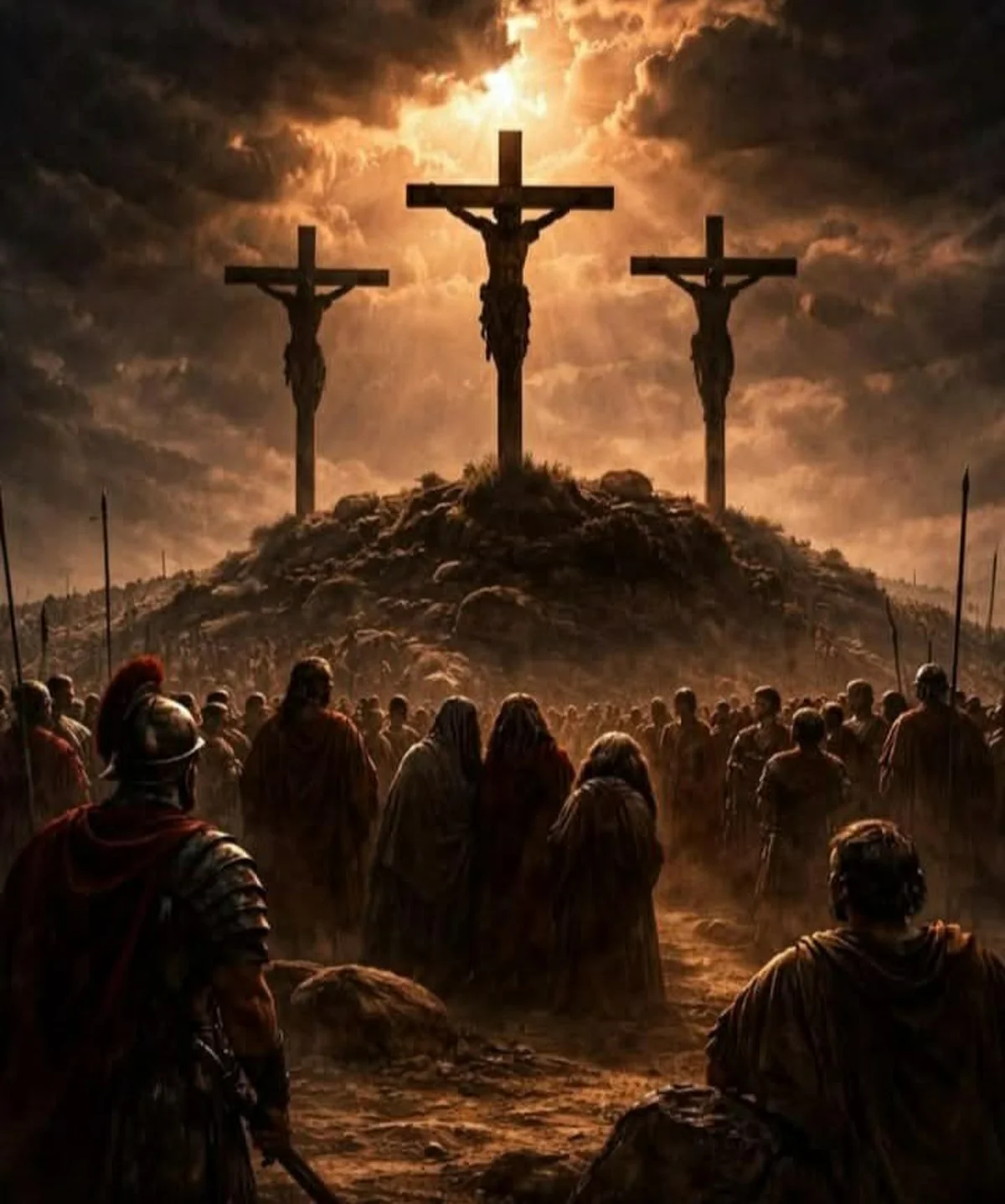
You reach the hill. It's crowded this is public theater, and Rome designed it that way on purpose, execution as warning, suffering as spectacle. You watch as they lay Him down on the wood. You hear or maybe you only imagine you hear, because your mind refuses to fully process it the sound of the nails.
They raise the cross. It drops into the hole with a jolt that must send agony through every nerve in His body. Two other men, criminals, are lifted up on either side of Him.
Above His head, Pilate has ordered a sign nailed: Jesus of Nazareth, King of the Jews. Written in Hebrew, Latin, and Greek, so nobody passing by can misunderstand it.
Three Hours in the Dark
The soldiers gamble for His clothing at the foot of the cross, indifferent to the man dying above them just another day at work.
The religious leaders who orchestrated all of this can't even let Him die in peace. They stand below and mock Him: "He saved others; He cannot save Himself." One of the criminals beside Him joins the taunting. The other battered, dying, out of options turns to Jesus instead and asks only to be remembered. Jesus tells him, "Today you will be with me in paradise."
You notice a small cluster of people standing closer than anyone else dares His mother, Mary, and a few of the women who followed Him from Galilee, along with one of His disciples, John. Jesus looks down at His mother, in the middle of His own execution, and makes sure someone will care for her. Even here. Even now.
Then, around noon, the sky goes dark. Not cloudy dark, in the middle of the day, for three full hours. You feel it in your chest before you understand it in your mind. Something is happening that is bigger than a Roman execution. The air itself seems to know it.
Around three in the afternoon, Jesus cries out with a loud voice words that sound like abandonment, like a man carrying something no human being was ever meant to carry alone. And then, He says, "It is finished." And He breathes His last.
At that exact moment, the ground shakes. Rocks split open. And somewhere behind the temple walls, out of sight of the crowd but not out of reach of the story, the massive curtain separating the Holy Place from the Most Holy Place sixty feet tall, according to some records, thick enough that oxen were said to be needed to tear it rips from top to bottom. Not bottom to top, the way a man could tear it. Top to bottom. The way only something else could.
The Roman centurion standing guard at the foot of the cross a man who has probably overseen dozens of executions, a man who has no religious stake in any of this looks up and says the words you never expected to hear from a soldier of Rome: "Truly this was the Son of God."
Now the Crowd Is Gone. It's Just You.
The spectacle is over. People are already drifting back toward the city, beating their chests, unsettled by what they just witnessed, already trying to make sense of it, already starting to forget.
But you're still standing there.
And here's the question that Golgotha leaves for every single person who has ever heard this story since: what would you actually have done?
It's easy to imagine yourself as one of the faithful women at the foot of the cross, or the centurion who spoke the truth out loud. But be honest with yourself for a moment. Isn't it more likely you'd have been somewhere in the middle of that crowd swept along, uncertain, staying quiet when it mattered, letting the loudest voices decide for you? Isn't that usually where we actually stand, in our real, everyday lives?
Because this story isn't only about one afternoon two thousand years ago. It's about every moment since when the crowd has been loud and the truth has been quiet. It's about the group chat where everyone is mocking something you know is wrong, and you have to decide whether to speak or scroll past in silence. It's about the workplace where standing by your convictions your Sabbath, your integrity, your faith might cost you something, and the easier road is simply to blend in. It's about the moments when following Jesus isn't dangerous exactly, just inconvenient, just unpopular, and you have to decide, all over again, which voice you're going to let speak through you.
Peter warmed his hands at that same crowd's fire and denied he even knew Jesus — three times, to three different people, before a rooster ever finished crowing. Pilate knew the truth and washed his hands of it anyway. The crowd that waved palm branches on Sunday was screaming for crucifixion by Friday. Five days. That's all it took.
So what would you have done?
More importantly: what will you do, the next time your own moment at Golgotha arrives, dressed in whatever ordinary clothing it wears today?
The centurion looked up at a dying man and finally saw the truth. It's never too late to do the same.
If this story moved something in you, sit with it a while longer. Ask God, honestly, where in your own life the crowd has been louder than His voice — and ask Him for the courage the centurion found, right at the foot of the cross.
Rose of Sharon is additionally thousands of believers come together to share testimonies, share prayer requests, participate in forums and join thousands of believers worldwide to strengthen each other in the Journey to heaven.
Get the app on Playstore and Appstore to comment.