If you have not read Part 1 — start there. This story begins at a crusade, with a stranger, a question about the Sabbath, and a cup of soya tea at midnight. You need Part 1 before this will land the way it is supposed to.
You woke up the next morning with the notebook still open on your desk.
You do not even remember falling asleep. At some point between the third page of notes and the fourth cup of soya tea, your head found the pillow and the questions carried you under. But they did not leave. They were there when you opened your eyes right where you had left them, sitting on your chest like a stone that had not moved overnight.
They rested on the Sabbath while He was in the grave.
Were they worshipping a dead God?
You sat up. Reached for your Bible before you reached for your phone. Before the notifications, before the morning noise, before anything else.
You needed to go back to Sunday morning.
Not our Sunday. Not a church service or a worship programme.
That Sunday morning.
The first one.
Before You Get There — Remember What Saturday Was
You need to feel the weight of that Sabbath before Sunday makes sense.
Close your eyes for a moment and put yourself there. Jerusalem. The air still carries the smell of the Passover lamb. Three days ago the city was alive with the festival pilgrims everywhere, the temple courts full, the streets loud. Now it is strange and quiet in the way that only follows something violent and wrong.
You are one of the women. Mary Magdalene. Or Mary the mother of James. Or Salome. Pick one it does not matter which. You are a woman who followed Jesus from Galilee, who supported His ministry, who stood at a distance and watched them crucify Him and could not look away and could not look at it either.
You went home Friday evening with burial spices in your arms and grief so heavy you could barely carry both.
And then the Sabbath came.
Luke 23:56 says it plainly,
"But they rested on the Sabbath in obedience to the commandment."
That is all. One sentence. No record of worship songs or prayers or community gathering. Just rest. In obedience. To the commandment.
Think about what obedience costs when everything in you is screaming to move. The body of the man you loved the man you believed was the Messiah, the One who was supposed to redeem Israel is lying in a borrowed tomb with a Roman seal on the stone. You have burial spices ready. You want to go. You need to go. The grief is unbearable and doing something would at least give it somewhere to go.
But the Sabbath says: stop.
And you stop.
Not because you feel like stopping. Not because worship feels natural or God feels near or any of it makes sense. You stop because the commandment says to stop. Because somewhere beneath the grief and the confusion and the shattered expectations, there is a faith that holds even when understanding has completely left the building.
Ellen White saw this clearly. In The Desire of Ages she wrote:
"The Sabbath that was such a day of grief and disappointment to the disciples was a day of peace and rest to Jesus. The work of redemption was accomplished. His labor was done. Having rested upon the seventh day from all His work, the Creator had looked upon His work and pronounced it good. Now the Redeemer rested from the work of redemption." --- The Desire of Ages, page 769
Read that again.
While the disciples were resting in grief and confusion Jesus was resting in completion.
Two groups resting on the same Sabbath. One in anguish. One in peace. Both in obedience to the same commandment. And neither group yet understood the full picture of what that rest meant.
Sunday Morning Comes Whether You Are Ready or Not
You have barely slept. The Sabbath passed like a long, grey held breath. The moment the sun dips below the horizon on Saturday evening your hands are already moving gathering the spices, wrapping your cloak, preparing to go before the light fully comes.
You leave before dawn. The streets of Jerusalem are empty and cool. Your sandals on the stone. The city still sleeping. The grief in your chest has not lessened but it has changed shape overnight it has become something with direction now, something that moves your feet.
Mark 16:1-2 records it like this:
"When the Sabbath was over, Mary Magdalene, Mary the mother of James, and Salome bought spices so that they might go to anoint Jesus' body. Very early on the first day of the week, just after sunrise, they were on their way to the tomb."
And then the thing none of them saw coming.
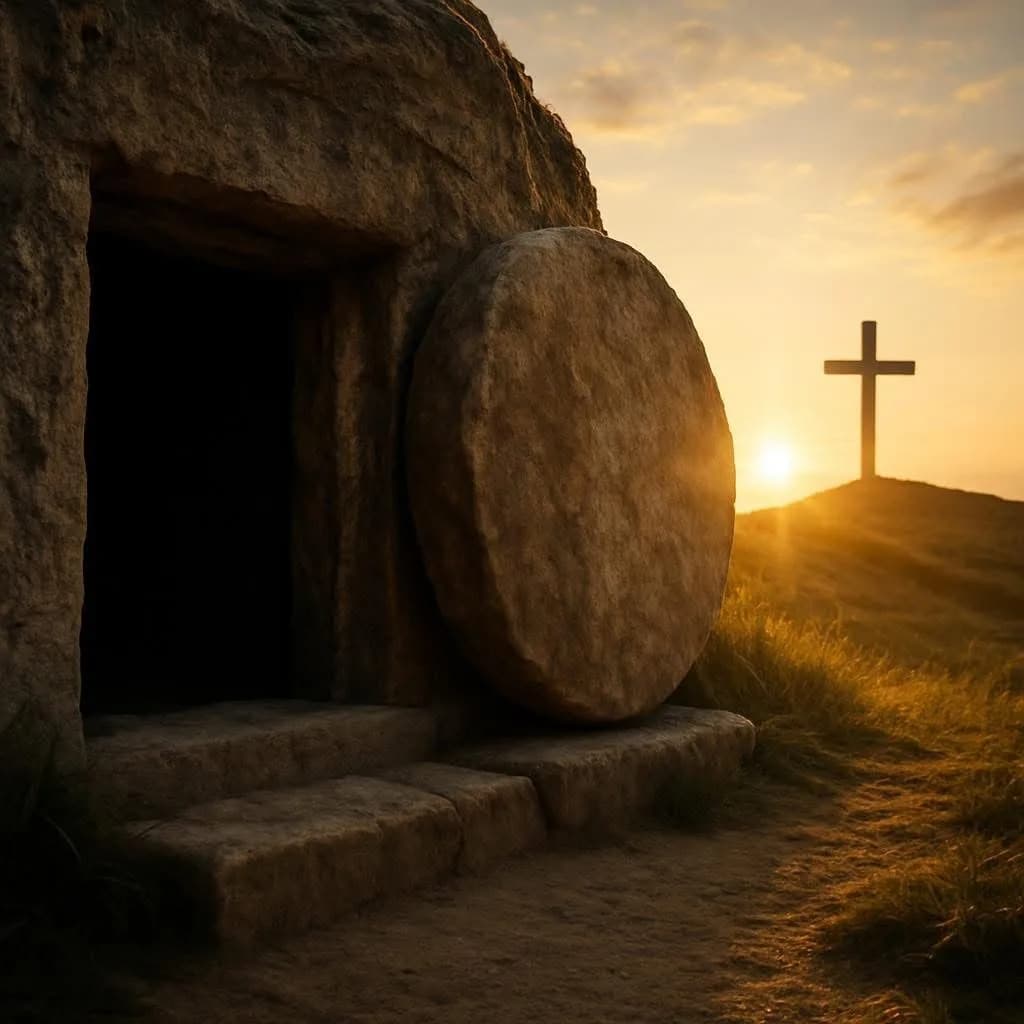
"They were asking each other, 'Who will roll the stone away from the entrance of the tomb?' But when they looked up, they saw that the stone, which was very large, had been rolled away." — Mark 16:3-4
The stone is gone.
Your mind cannot process it. You look at the women beside you. They are looking at you. Nobody speaks. You take a step forward. Then another.
You go inside.
And there is a young man in white, sitting on the right side.
"Don't be alarmed," he says. "You are looking for Jesus the Nazarene, who was crucified. He has risen! He is not here. See the place where they laid him." — Mark 16:6
He has risen.
Two words that split the history of the universe in half.
Everything that happened before those two words is one world. Everything after is another.
Now Go Back to the Mahindi Choma Man's Question
You are in your room the morning after the crusade now. Bible open. Tea getting cold. The green notebook beside you.
You have been carrying the man's question for almost twelve hours:
"Were they worshipping a dead God on that Sabbath?"
And now sitting with the full picture in front of you, the Friday crucifixion and the Saturday silence and the Sunday morning that rearranged everything you finally see the answer.
No.
They were not worshipping a dead God.
They were worshipping the same God who had instituted the Sabbath in Eden before sin ever entered the world. The same God whose existence and authority and holiness does not depend on whether we can see or feel or understand what He is doing. The Sabbath was given as a memorial of creation — Genesis 2:2-3 establishes this:
"By the seventh day God had finished the work he had been doing; so on the seventh day he rested from all his work. Then God blessed the seventh day and made it holy, because on it he rested from all the work of creating that he had done."
The Sabbath existed before the cross. It did not require the resurrection to be valid. It required only the Creator and the Creator was not defeated on Calvary. He was completing something.
Ellen White puts it with perfect clarity in The Desire of Ages:
"It was to honor the Sabbath that Joseph of Arimathea and Nicodemus hastened the burial of Jesus before the setting sun on Friday. It was in honor of the Sabbath that the women refrained from completing the anointing of the body. They did not think of the Sabbath as a day of mourning or as a cessation of service to God. It was still the holy day even then."
Still the holy day. Even then.
Even on the darkest Saturday the world has ever seen, the Sabbath was not suspended. It was not cancelled by grief or confusion or theological uncertainty. It was honoured quietly, painfully, obediently by people who could not see past the stone.
What Sunday Morning Did Not Do
Here is where it gets important. And here is where many people get confused.
Sunday morning did not replace the Sabbath.
This is the question underneath the question. The man beside you was not just asking about those disciples on that particular Saturday. He was asking whether he knew it or not about what Christians do with the Sabbath now that the resurrection has happened. He was asking whether Sunday swallowed Saturday whole.
It did not.
Look at what happened on that first Sunday. The disciples did not gather for worship. They hid. They doubted. Thomas was not even there. The two on the road to Emmaus were walking away from Jerusalem away from the community, away from the upper room in defeat. Luke 24:21 records their exact words to the stranger walking beside them:
"But we had hoped that he was the one to redeem Israel. And what is more, it is the third day since all this took place."
We had hoped. Past tense.
There was no Sunday worship service. There was no gathering in the name of the resurrection. There was shock and disbelief and joy so overwhelming that some of them thought they were seeing a ghost.
The resurrection of Jesus is the most important event in human history. But it did not come with a commandment to change the day of worship. Not one verse in the New Testament records Jesus saying now that I have risen, move the Sabbath to Sunday. Not one.
What the resurrection did was give the Sabbath its deepest meaning.
The same way creation Sabbath was the rest of completion the work of making the world declared finished and good the tomb Sabbath was the rest of redemption. The work of saving the world declared finished and done. It is finished. He lay down on the Sabbath the way the Creator lay down on the seventh day of creation week in the rest of a completed work.
Ellen White writes in The Great Controversy:
"The Sabbath is a sign of Christ's power to sanctify us. And it is given to all whom Christ makes holy. As a sign of His sanctifying power, the Sabbath is given to all who through Christ become a part of the Israel of God."
The Sabbath after the resurrection is not a memorial of a dead tradition. It is the sign of a living Saviour whose completed work of redemption gives us reason to rest that we never had before Calvary.
The Conversation You Wish You Had Continued
You put your Bible down and look at your notebook.
You think about the man. The mahindi choma. The way he disappeared before the benediction without a word.
You wish he were here now. Sitting across from you at your desk while the morning light comes through the curtains. You would say it like this:
"You asked whether they were worshipping a dead God on that Sabbath. Here is what I think now. They were worshipping the same God they had always worshipped the Creator God of Genesis, the covenant God of Exodus, the promise-keeping God who does not become less God when He is silent. They kept the Sabbath in the dark because the Sabbath was never about what they could see. It was always about who He is. And on Sunday morning they discovered that who He is , is Someone who does not stay in tombs."
You would watch his face as that landed.
And then you would say one more thing.
"The Sabbath they kept while He was in the grave was actually the most honest Sabbath any human being has ever kept. Because they kept it with nothing to show for it. No miracle in progress. No visible evidence. Just a commandment and a God they still chose to trust even when trust cost everything."
The Kind of Sabbath Keeper God Is Looking For
Here is what stayed with you most, sitting in your kitchen at midnight with the blue chipped cup.
It is easy to keep the Sabbath when worship is good and the sermon moves you and the music carries you and God feels close and everything in your life is in order.
But the disciples on that Saturday? They kept the Sabbath when the tomb was sealed and they had no answers and their faith was in ruins and God felt not just silent but absent and dead.
And God honoured that Sabbath more than any comfortable Sabbath ever kept.
Because that is what faith actually is. Not the faith that sings loudly when everything is going well. The faith that rests on the seventh day when the stone is still sealed and Sunday has not happened yet.
Hebrews 11:1 says:
"Now faith is confidence in what we hope for and assurance about what we do not see."
Assurance about what we do not see.
That is the Sabbath of trust. That is the rest the commandment is calling you to — not just the physical rest of stopping work, but the deep spiritual rest of releasing control. Of saying to God: I do not understand what you are doing behind this stone. I cannot see past Friday's grief into Sunday's joy. But I will honour this day. I will lay it all down. I will trust that you are not finished.
Because He is never finished.
The stone always moves.
Sunday always comes.
Before You Close Your Bible This Morning
You close the green notebook. Both of them now the first one and the second one, both halfway full from a single crusade night that became something far bigger than a crusade.
You look at Luke 23:56 one final time.
"But they rested on the Sabbath in obedience to the commandment."
Eight words. No explanation. No theological footnote. No emotional qualifier.
They rested. In obedience. To the commandment.
And on the other side of that obedience on the other side of one dark, silent, confusing, grief-soaked Sabbath was the most glorious morning the world has ever seen.
That is the promise embedded in every Sabbath you will ever keep.
Rest in obedience. Even in the dark. Even when you cannot see. Even when the stone looks permanent and the silence feels like abandonment.
Because Sunday is coming.
It always comes.
"The Sabbath was given to man as a memorial of the creation and as a sign of God's power. When men keep the Sabbath holy, they testify to the world that they believe in God as the Creator and Redeemer." — Ellen White, Testimonies for the Church,
This Series Is Complete — But Your Sabbath Is Not
This is Part 2 of 2 of Questions From the Back Row.
If this series stirred something in you a question, a conviction, a deeper desire to understand what the Sabbath actually means beyond the routine of Friday sunset to Saturday sunset then you are exactly who the Rose of Sharon community was built for.
We are a community of believers who are not afraid to sit with hard questions and follow them all the way to honest, biblical, Spirit-led answers.
The Rose of Sharon app has a dedicated Sabbath devotional series, daily scripture, and a community of Adventist believers across the world and beyond who are asking the same questions you are.
🔔 New Series Starting Soon
Next week we begin a brand new series: "What Ellen White Actually Said" — going back to the original sources, reading the quotes in full context, and discovering that the prophet said things far more surprising than most of us were taught.
Join Rose of Sharon WhatsApp channel so you do not miss Part 3:
https://whatsapp.com/channel/0029VbCFhhIH5JM6Je9krr1C
Forward this article to one Adventist friend today. Not because we asked you to — but because you know someone who needs to read it. 🙏